 Defillama
Defillama yields: Pool APY Components and Calculation Rules
Defillama yields compare annual percentage yield (APY) using unboosted pool rates and reward components that meet defined inclusion rules. Base yield can reflect lending interest or trading fees; reward yield reflects eligible token incentives. Locked rewards, pre-mined rewards and non-tradable incentives fall outside that calculation. Fee-based APY uses a 24-hour observation window. These choices explain why a displayed rate can differ from a protocol's promoted figure and why the pool's base and reward components matter when comparing returns.
· last updated
Earn, borrow and Loop rate comparisons
Earn compares pools through APY, total value locked (TVL) and other metrics across chains. Borrow covers lending markets and borrowing routes, while Loop covers leveraged lending strategies. Reference Rates provides benchmarks for stablecoin supply and borrowing rates. These views address different positions: earning on supplied assets, paying for borrowed assets or combining lending with leverage. A supply-pool rate therefore needs different context from a leveraged strategy rate, where the borrowing side also affects the return.
What do base APY and reward APY measure?
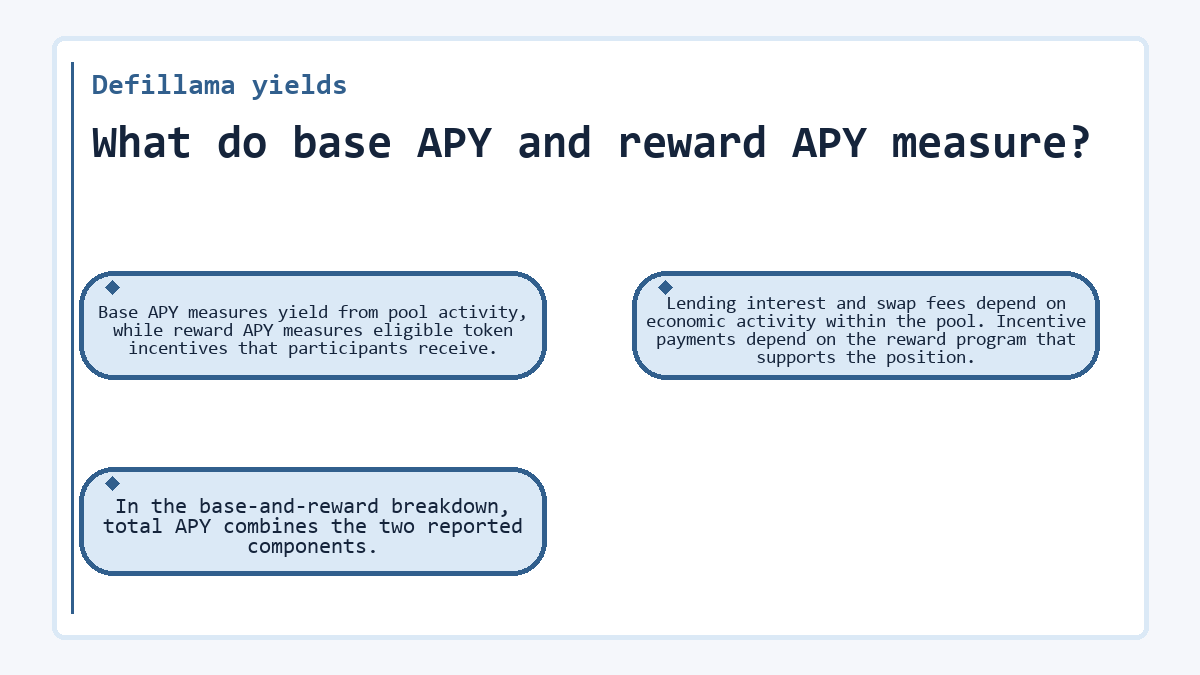
Base APY measures yield from pool activity, while reward APY measures eligible token incentives that participants receive. Lending interest and swap fees depend on economic activity within the pool. Incentive payments depend on the reward program that supports the position. In the base-and-reward breakdown, total APY combines the two reported components.
Income from supplying assets or liquidity
The base component describes income from supplying assets or providing liquidity, where those activities generate a return. In lending, borrowers pay interest that contributes to supplier income. In a trading pool, swaps generate fees that can contribute to liquidity-provider income. The underlying mechanism determines the calculation, so a lending rate and a trading-fee rate can respond to different activity.
Pool yield describes income for the supplied position. Protocol revenue measures income retained after supplier payments. The same underlying activity can produce both, with different recipients and calculation bases.
Incentive payments and incomplete breakdowns
The reward component captures eligible incentives paid in tradable tokens. A pool can have only base APY, only reward APY or both. An adapter can also provide total APY without a component breakdown when its data does not support the split. The available fields determine whether an entry supports separate comparisons of activity income and incentives.
Intrinsic yield from underlying assets
Some underlying assets carry their own yield, including liquid staking tokens, liquid restaking tokens and yield-bearing stablecoins. Adapters can flag these assets as intrinsic yield sources for links to downstream pools. This mechanism distinguishes yield carried by an asset from separately paid incentives. An intrinsic APY link does not establish that every downstream pool applies an extra reward program.
Which rewards qualify for pool APY?
Reward APY includes incentives paid in already tradable tokens and excludes pre-mined rewards, locked rewards and non-tradable incentives. Points before a token generation event do not qualify. Neither do non-transferable tokens. A projected value for future points does not turn them into an eligible reward payment. These inclusion rules explain a difference between the standard displayed rate and a promotion that assigns value to additional benefits.
Extra-token boosts
Yield that requires an additional token beyond the liquidity-provider (LP) token falls outside the calculation. A promoted boosted rate can describe a different eligibility state from the unboosted position.
Locked rewards and early-exit reductions
Locked rewards remain excluded even when the reward token itself trades elsewhere. If leaving a pool early reduces rewards, the APY calculation uses the lower-bound value. That adjustment accounts for the stated exit condition; it does not set a guaranteed floor for future earnings. The exclusion concerns rewards. It does not establish that deposited assets have unrestricted withdrawals, since reward eligibility and principal withdrawal terms answer different questions.
How does the fee window affect annual APY?
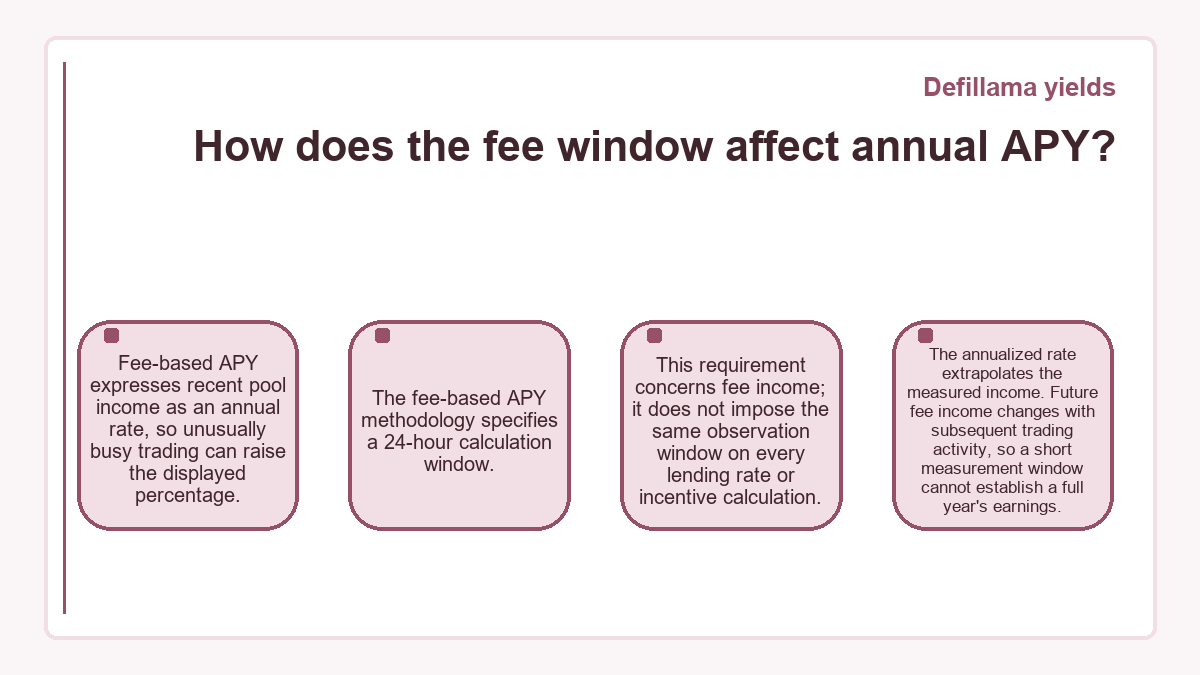
Fee-based APY expresses recent pool income as an annual rate, so unusually busy trading can raise the displayed percentage. The fee-based APY methodology specifies a 24-hour calculation window. This requirement concerns fee income; it does not impose the same observation window on every lending rate or incentive calculation. The annualized rate extrapolates the measured income. Future fee income changes with subsequent trading activity, so a short measurement window cannot establish a full year's earnings.
Conditions for a comparable pool rate
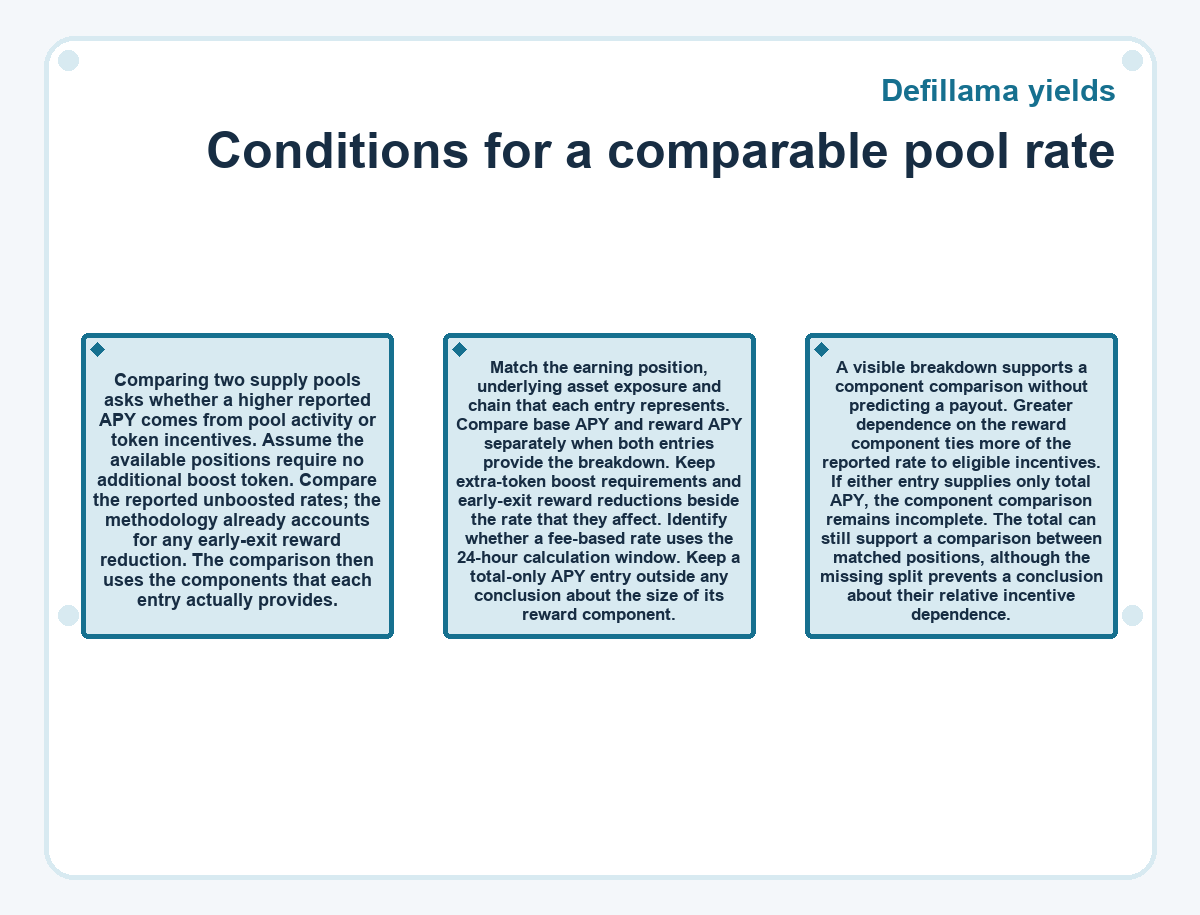
Comparing two supply pools asks whether a higher reported APY comes from pool activity or token incentives. Assume the available positions require no additional boost token. Compare the reported unboosted rates; the methodology already accounts for any early-exit reward reduction. The comparison then uses the components that each entry actually provides.
- Match the earning position, underlying asset exposure and chain that each entry represents.
- Compare base APY and reward APY separately when both entries provide the breakdown.
- Keep extra-token boost requirements and early-exit reward reductions beside the rate that they affect.
- Identify whether a fee-based rate uses the 24-hour calculation window.
- Keep a total-only APY entry outside any conclusion about the size of its reward component.
A visible breakdown supports a component comparison without predicting a payout. Greater dependence on the reward component ties more of the reported rate to eligible incentives. If either entry supplies only total APY, the component comparison remains incomplete. The total can still support a comparison between matched positions, although the missing split prevents a conclusion about their relative incentive dependence.
Pool identifiers and rate units
Pool entries identify positions through a pool identifier, chain and protocol. Their metadata can distinguish markets, fee tiers, lock durations and strategies that a shared asset symbol leaves unresolved.
Underlying assets and reward assets
Underlying token fields identify the pool's assets, while reward token fields identify the assets used for incentive payments. A reward token can differ from the asset supplied to the pool. A separate incentive asset introduces another price input when token income receives a dollar valuation. Reward eligibility determines inclusion in the calculation, while the reward token's market price affects its value. An earning percentage alone does not specify conversion of an incentive payment into the deposited asset.
Annual rates and dollar valuations
APY reports a percentage rate, whereas TVL reports the dollar value of pool assets. The annual label also does not establish automatic reinvestment of every reward payment; compounding depends on the position's actual mechanics. An unchanged APY can accompany a falling dollar value when the underlying asset loses value.
Defillama yields: questions and answers
Why can lending-pool TVL differ from total supplied assets?
Lending-pool TVL uses total supplied value minus total borrowed value. In the pool data, that relationship is tvlUsd = totalSupplyUsd - totalBorrowUsd. Total supply and net locked value therefore describe different balances.
Does an ERC-4626 pricePerShare value represent a dollar price?
The pricePerShare field represents underlying assets per share, not a USD price. For an ERC-4626 position, it can express the assets represented by one vault share. A dollar valuation also needs the underlying asset's price. Confusing these units can turn a share conversion ratio into a mistaken return calculation.
Can a lending market have liquidity while new borrowing is disabled?
A lending market can report available liquidity while its configuration prevents new borrowing. The borrowable field indicates whether a new borrow can open for that asset. The availableBorrowUsd field measures available borrowing liquidity with caps and constraints accounted for. A false borrowable value alone does not require that liquidity figure to become zero.
Do pool token and underlying token addresses identify the same asset?
A pool token address can identify an LP token, a vault receipt token or a staked asset token. Underlying token addresses identify the assets represented by the position. These fields have separate roles, so they do not always name the same token.
Where do yield adapters obtain their rate data?
Yield adapters obtain data through on-chain calls or subgraphs. Centralized API calls are accepted only when no other method can obtain the required data. Off-chain gauge weights can require this exception.
Is historical APY available for an individual pool?
Historical pool chart data includes APY and TVL for an individual pool identifier. Those records track the rate and pool size across recorded periods. History for another market, chain or strategy belongs to that position's own records.
What asset does the borrowToken field identify?
The borrowToken field identifies the underlying asset that a borrower receives. It does not name a debt receipt token.