 Defillama
 Defillama: Revenue vs Earnings After Token Incentives
Defillama separates protocol revenue from earnings by deducting token incentives that the protocol distributes to users. Revenue measures the portion of fees that goes to the protocol, its team or token holders after supplier payments. Earnings then account for rewards that support liquidity mining, farming or similar activity. The distinction changes which ranking answers an economic question: revenue describes fee capture, while earnings show the balance after incentives. A high revenue figure can coexist with negative earnings when rewards exceed retained fees. Neither measurement alone establishes net profit after operating expenses or the income that reaches a particular token holder.
· last updated
Which metric helps compare dependence on token incentives?
Earnings provide the closer comparison because they account for the value of token rewards. Revenue remains useful for assessing fee income after supplier payments. The choice turns on the question: whether a protocol captures income from activity, or whether that income covers its recorded incentive spending.
Category and chain filters define the comparison group. Related protocol functions offer a more consistent basis for comparison than a ranking that mixes different business models.
Token incentives have economic value even when the protocol distributes tokens without paying the equivalent amount from a cash reserve.
An earnings balance does not establish how much activity would remain after rewards ended. Revenue and incentive spending describe the measured period without isolating how much of that revenue the reward program caused.
Fee allocation before token incentives
Fees capture the income that protocol activity generates before any share goes to suppliers, including the interest that borrowers pay in lending and the fees that traders pay for decentralized swaps. Retained revenue depends on the allocation of those fees, so a busy protocol need not keep most of the income that its activity generates.
Payments with different accounting roles
The supplier share of fees
Liquidity providers and lenders can receive a portion of the fees that users pay. Those payments compensate suppliers of capital and reduce the amount classified as revenue. Removing that share establishes the revenue boundary before the earnings calculation begins. Deducting the same supplier payment again would understate earnings.
Token incentive emissions
Token rewards create a separate cost when a protocol emits incentives for liquidity mining, farming or similar programs. Their economic value enters the incentive deduction. A reward received by a participant therefore has a different accounting role from a fee that the participant pays to use the protocol.
The incentive-adjusted balance
Earnings equal revenue minus the value of token incentives distributed over the same period. Revenue exceeding incentives produces a positive balance, while incentives exceeding revenue produce a negative balance. Equal values leave no surplus under this calculation.
The formula uses incentive value, not a raw count of reward tokens. Revenue and incentives must share a valuation unit for their difference to represent an economic balance.
Calculation stages for a matched earnings comparison
An incentive-dependence comparison asks whether retained fee income covers reward spending for the selected protocol and period. The calculation follows fee allocation before applying the incentive deduction. Fees and revenue count on their accrual dates; incentives reflect rewards emitted during the matched period.
| Calculation stage | Interpretation error |
|---|---|
| Measure the fees associated with the selected activity and period. | Treating total fees as income that the protocol retains. |
| Exclude the fee share distributed to suppliers to identify revenue. | Deducting supplier payments again after revenue already excludes them. |
| Subtract token incentive value from revenue for that period. | Combining revenue and rewards from different periods or protocol scopes. |
The final balance supports a comparison of income after incentive costs. It applies to the activity that the listing covers and the period that the inputs share. A protocol-wide revenue total combined with rewards from only one product would leave part of the incentive cost outside the comparison.
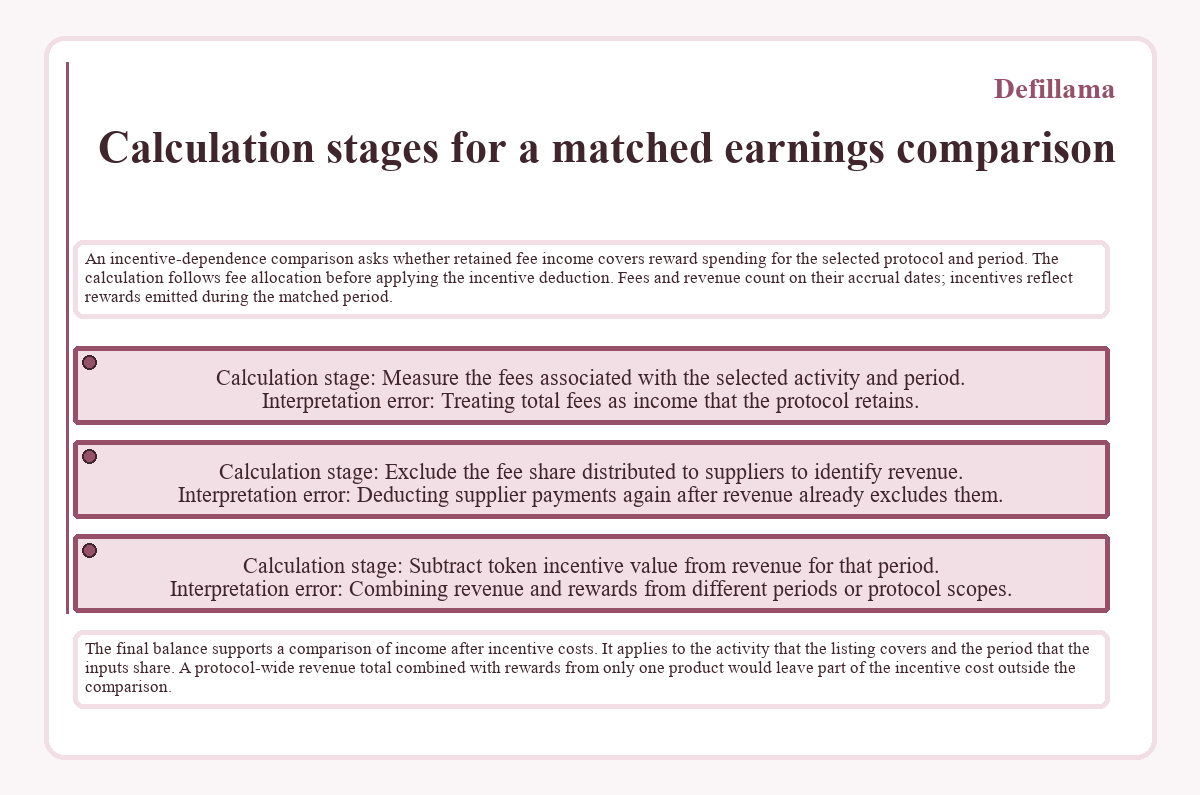
Calculation stages for a matched earnings comparison
- Calculation stage: Measure the fees associated with the selected activity and period. Interpretation error: Treating total fees as income that the protocol retains.
- Calculation stage: Exclude the fee share distributed to suppliers to identify revenue. Interpretation error: Deducting supplier payments again after revenue already excludes them.
- Calculation stage: Subtract token incentive value from revenue for that period. Interpretation error: Combining revenue and rewards from different periods or protocol scopes.
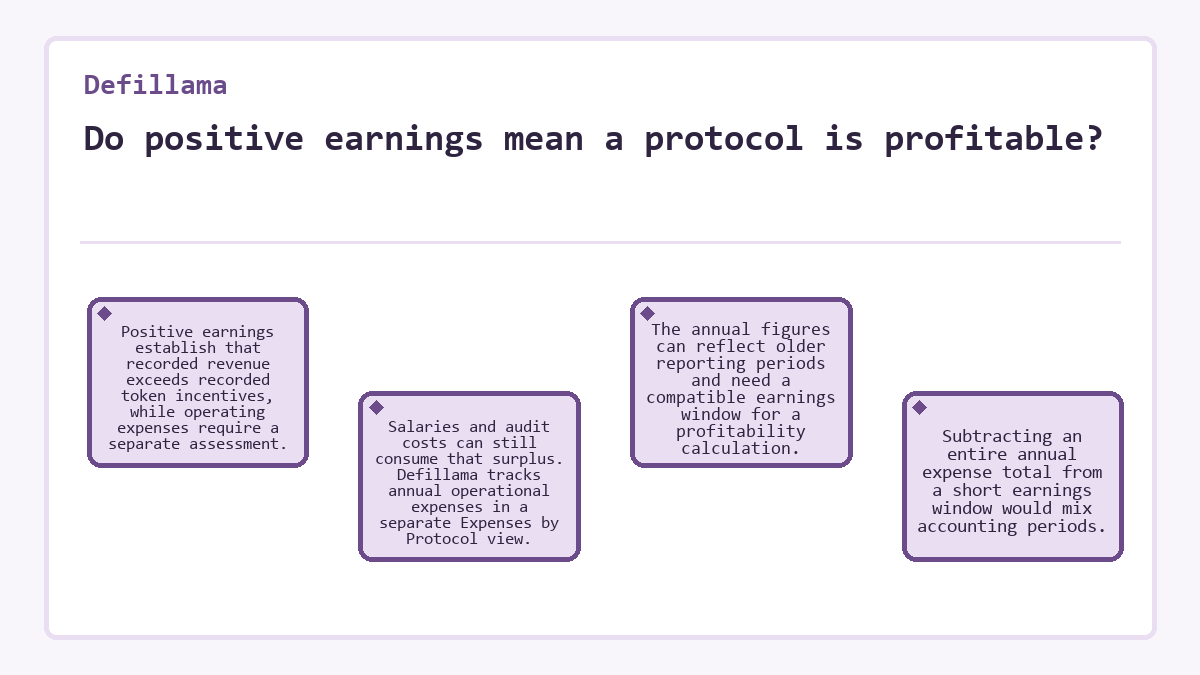
Do positive earnings mean a protocol is profitable?
Positive earnings establish that recorded revenue exceeds recorded token incentives, while operating expenses require a separate assessment. Salaries and audit costs can still consume that surplus. Defillama tracks annual operational expenses in a separate Expenses by Protocol view. The annual figures can reflect older reporting periods and need a compatible earnings window for a profitability calculation. Subtracting an entire annual expense total from a short earnings window would mix accounting periods.
Revenue allocation and holder outcomes
Revenue allocation determines where the retained fee income goes. Protocol Revenue identifies the share allocated to the treasury or core team. Holder revenue concerns value directed to governance token holders through mechanisms such as buybacks, burns or distributions. An aggregate earnings figure does not specify which recipient receives the remaining economic value.
Holder revenue can also include external income directed to governance token holders, and distribution timing can differ from the measurement period in which the fee revenue that funds a particular payment accrues. These features prevent a simple daily reconstruction of protocol income from holder payments alone. Pool yields concern the return available to participants; incentive-adjusted earnings concern the protocol's revenue after incentive costs. The recipient and the protocol occupy different sides of the reward payment.
Measurement periods and incentive changes
Comparable earnings require matching periods, listing coverage and valuation units. The earnings table includes 24-hour, seven-day and 30-day totals. These windows measure different amounts of activity and reward spending. A larger monthly total does not itself demonstrate stronger daily performance, and a short positive window does not establish a sustained surplus. A whole protocol and one product also capture different activity. Neither a category label nor a shared chain makes those scopes identical.
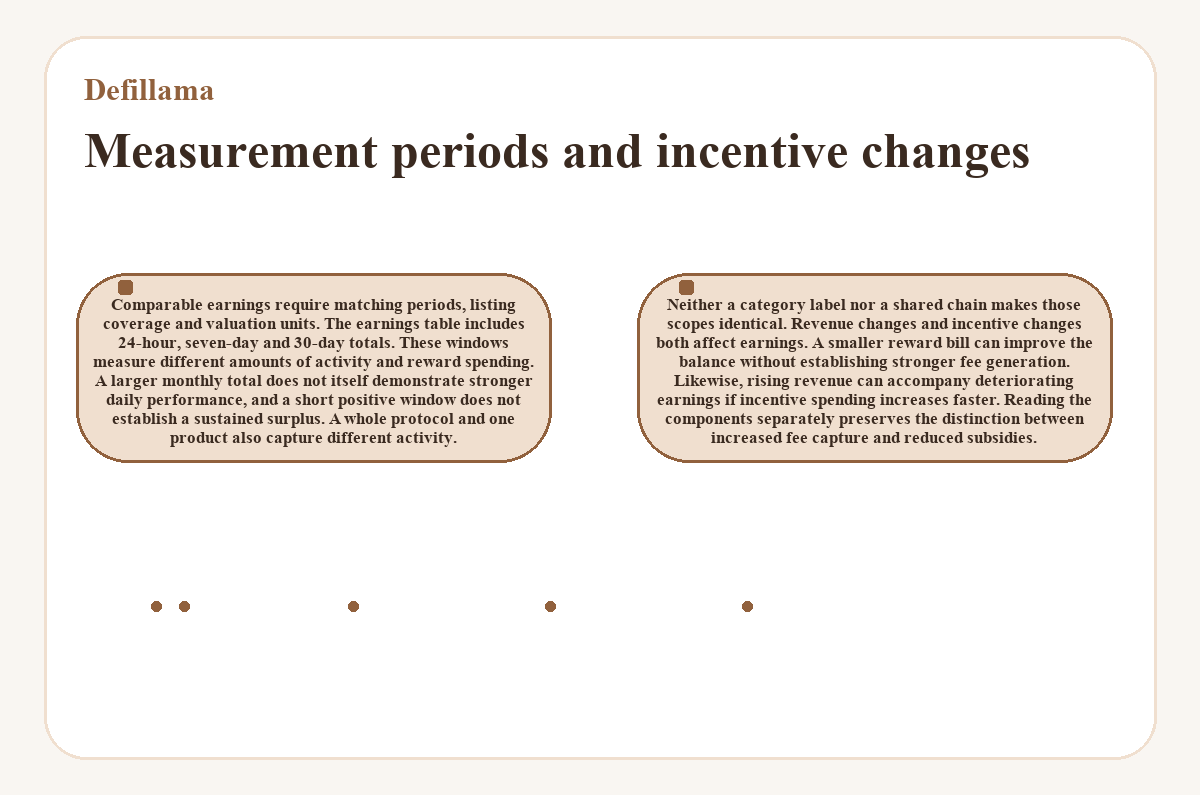
Revenue changes and incentive changes both affect earnings. A smaller reward bill can improve the balance without establishing stronger fee generation. Likewise, rising revenue can accompany deteriorating earnings if incentive spending increases faster. Reading the components separately preserves the distinction between increased fee capture and reduced subsidies.
P/S and the revenue denominator
The P/S ratio divides token market capitalization by annualized protocol revenue. Its denominator sits before the incentive deduction. The P/F ratio instead uses annualized fees, so supplier allocations can create a substantial difference between the figures even when both ratios describe the same protocol.
Annualizing a measured income stream rescales that stream to a yearly basis. It does not establish what the protocol will earn over the coming year. Reward spending can change separately from revenue, and a revenue-based valuation ratio leaves that cost outside its denominator.
A positive revenue denominator can therefore coexist with negative earnings. P/S answers a valuation question about retained fee income; the earnings balance answers whether that income covers recorded incentives. The formula remains P/S = market capitalization / annualized revenue.
Practical questions about Defillama
Are token unlocks automatically an expense in Defillama earnings?
Token unlocks do not automatically equal incentive spending. An unlock changes when a token allocation becomes available. Earnings deduct the value of rewards emitted during the measured period, so an unlock belongs in that deduction only when it represents an incentive distribution.
When does Defillama recognize protocol fees and revenue?
Defillama recognizes fees and revenue on their accrual date. A payout or collection date can differ. Interest accumulated across an earlier period does not all become new revenue when someone repays it. This timing rule matters when aligning income with the incentive deduction.
Can I add parent and child revenue totals when calculating earnings?
A parent protocol total already aggregates its child listings, so adding both would double count the included revenue. Separate products and versions can have their own listings. Use either the relevant aggregate or its constituent listings consistently when defining the scope of an earnings comparison.
Does a treasury-funded buyback count as holder revenue?
A buyback financed from existing treasury reserves does not qualify as holder revenue under this definition. Qualifying buybacks use actual revenue receipts, while minting tokens and burning them also fails that criterion. The funding origin matters when interpreting holder distributions alongside protocol earnings.
Why can a protocol report negative fees before incentives?
Negative fees can reflect realized losses such as a vault drawdown or negative yield. The accounting records those losses instead of forcing the fee value to zero. This differs from a negative earnings balance caused by token incentives exceeding otherwise positive revenue.
Is chain app revenue a complete total for an earnings comparison?
App Revenue by Chain excludes stablecoins, liquid staking applications and gas fees. It therefore measures a filtered application aggregate, not every income stream associated with the chain. Comparing that total with protocol earnings requires compatible activity coverage as well as a matching measurement period.