 Defillama
Defillama stablecoins track circulating supply and its distribution across chains
Defillama stablecoins dashboards show circulating supply, market capitalization and how stablecoin balances distribute across blockchains. Supply accounting distinguishes assets issued on a chain from balances bridged onto it. That distinction helps explain whether a network's growing stablecoin balance reflects issuance or redistribution. Supply totals count circulating tokens, while market capitalization values them at the asset's price. Neither figure alone establishes the liquidity available for a trade or the backing available for redemption.
· last updated
In short: A growing chain balance can reflect bridged redistribution, so its change alone does not establish additional global stablecoin issuance.
Market totals and chain distribution
Asset totals describe the size of a tracked stablecoin, while chain distributions show where its supply circulates. A market-wide view combines tracked assets; a chain view narrows the location. Each answers a different question about concentration. An asset can appear across several networks, and a network can contain several stablecoins. The chain label therefore identifies location without turning every listed balance into the same token. Supply distribution also describes holdings at a point in time. It does not measure the amount transferred or traded during that period.
A chain's stablecoin market cap reflects the balances attributed to its tracked assets and their valuation. A change in the chain's share can occur even while total market supply remains unchanged. Conversely, new issuance can increase the market total without increasing every chain's balance. Comparing the same asset and observation period keeps those questions separate. Mixing a market-wide total with a filtered chain series changes the denominator, even when both measurements use dollars.
Native issuance and bridged balances
Native issuance and bridged balances describe different origins within a chain's stablecoin accounting. Supply adapters report minted assets for issuance on the reporting chain. Separate bridge entries identify the chain from which a balance originated. An incoming bridged balance describes an asset represented on another network. Its arrival does not, by itself, prove that the issuer created additional circulating supply. Native issuance can also occur on several chains, so a shared stablecoin name across networks does not establish a bridge route.
Unreleased reserves hold tokens that have never circulated. Their existence explains why a contract's minted supply can exceed its circulating amount.
Bridge accounting depends on the relationship between origin and destination balances. Adding locked backing and its bridged representation as independent issuance would overstate the underlying amount. With these adapter fields, chain circulation is native issuance plus incoming bridged balances, minus unreleased reserves and balances bridged out. The asset total sums the resulting chain circulation amounts. They do not establish identical backing or redemption terms for every token representation.
Supply fields and API selectors
Supply adapters classify issuance and reserves, while API selectors choose the asset or chain whose record appears. These fields describe different layers of the dataset. They do not form a single request or a complete token specification. Their meanings explain why a contract's issuance figure, a chain distribution and a filtered historical chart can answer different questions.
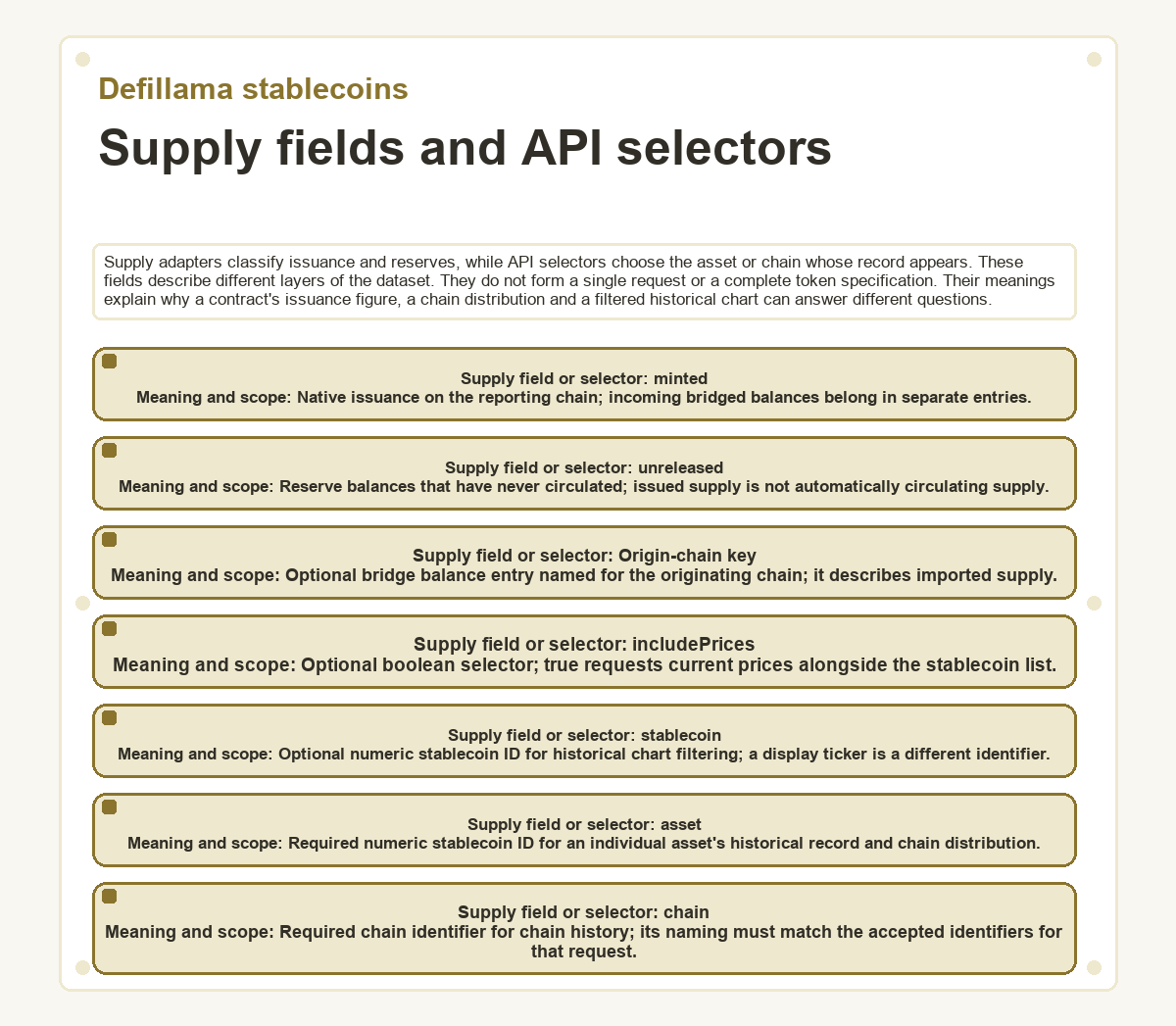
Supply fields and API selectors
- Supply field or selector: minted Meaning and scope: Native issuance on the reporting chain; incoming bridged balances belong in separate entries.
- Supply field or selector: unreleased Meaning and scope: Reserve balances that have never circulated; issued supply is not automatically circulating supply.
- Supply field or selector: Origin-chain key Meaning and scope: Optional bridge balance entry named for the originating chain; it describes imported supply.
- Supply field or selector: includePrices Meaning and scope: Optional boolean selector; true requests current prices alongside the stablecoin list.
- Supply field or selector: stablecoin Meaning and scope: Optional numeric stablecoin ID for historical chart filtering; a display ticker is a different identifier.
- Supply field or selector: asset Meaning and scope: Required numeric stablecoin ID for an individual asset's historical record and chain distribution.
- Supply field or selector: chain Meaning and scope: Required chain identifier for chain history; its naming must match the accepted identifiers for that request.
| Supply field or selector | Meaning and scope |
|---|---|
minted
|
Native issuance on the reporting chain; incoming bridged balances belong in separate entries. |
unreleased
|
Reserve balances that have never circulated; issued supply is not automatically circulating supply. |
| Origin-chain key | Optional bridge balance entry named for the originating chain; it describes imported supply. |
includePrices
|
Optional boolean selector; true requests current prices alongside the stablecoin list. |
stablecoin
|
Optional numeric stablecoin ID for historical chart filtering; a display ticker is a different identifier. |
asset
|
Required numeric stablecoin ID for an individual asset's historical record and chain distribution. |
chain
|
Required chain identifier for chain history; its naming must match the accepted identifiers for that request. |
What changes stablecoin market cap?
Stablecoin market cap changes when circulating supply changes, when the valuation price changes or when both change together. Stablecoin market cap equals circulating supply multiplied by the asset's price. At dollar parity, a dollar-pegged token's quantity and dollar valuation are numerically equal. That equality depends on both the peg and the valuation basis. A deviation from parity can change dollar market cap without a matching change in token count. Burned and non-issued tokens fall outside the circulating supply that the measurement uses.
Assets pegged to another currency can change dollar valuation when exchange rates move. A variable peg also needs its own reference value. A quoted price above a dollar does not establish a depeg for every asset. Comparison requires the relevant peg and unit alongside the circulation record. Market size describes valuation. It does not show the reserves that back the token or establish a holder's ability to redeem it.
Does stablecoin supply measure DeFi deposits?
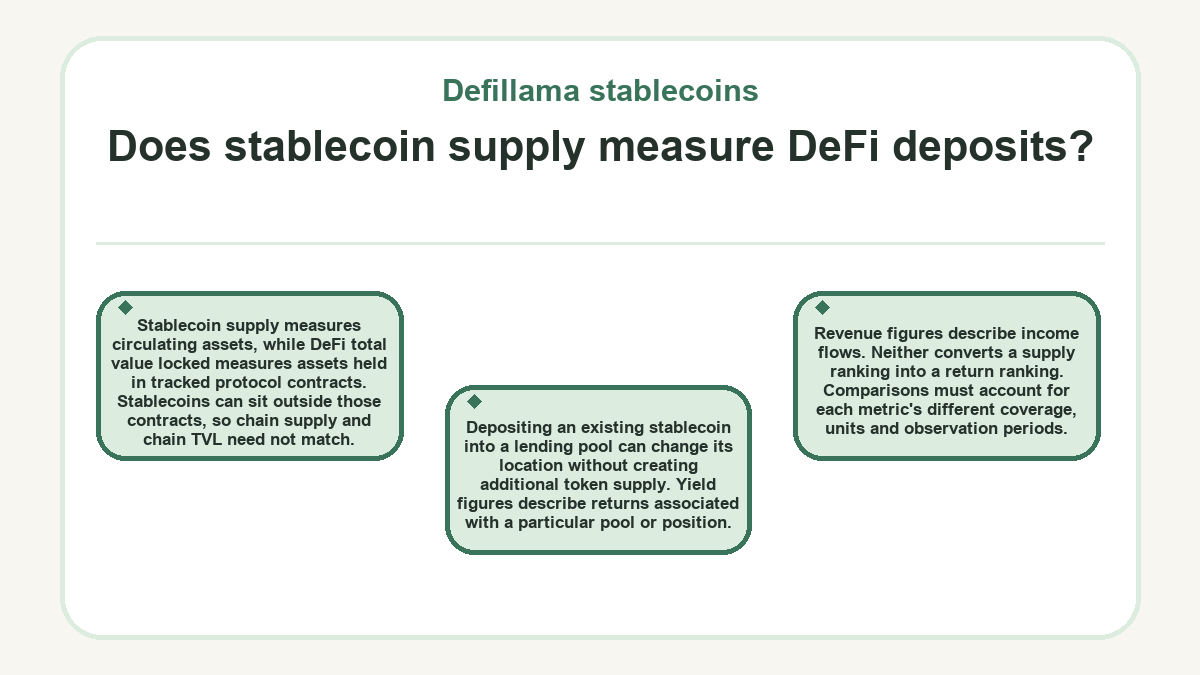
Stablecoin supply measures circulating assets, while DeFi total value locked measures assets held in tracked protocol contracts. Stablecoins can sit outside those contracts, so chain supply and chain TVL need not match. Depositing an existing stablecoin into a lending pool can change its location without creating additional token supply. Yield figures describe returns associated with a particular pool or position. Revenue figures describe income flows. Neither converts a supply ranking into a return ranking. Comparisons must account for each metric's different coverage, units and observation periods.
Historical series and observation times
Historical stablecoin records distinguish aggregate market history, chain history and an individual asset's distribution over time. The API returns dated observations, making the selected asset and chain part of the comparison. Stablecoin supply updates hourly. That schedule describes snapshots rather than an instant accounting feed for every mint or bridge event. A chart's latest point answers a question about its recorded observation time. It does not establish that a just-submitted transfer has settled or that tokens have reached a particular account.
Compare chain records and asset totals from the same observation time before judging whether they reconcile.
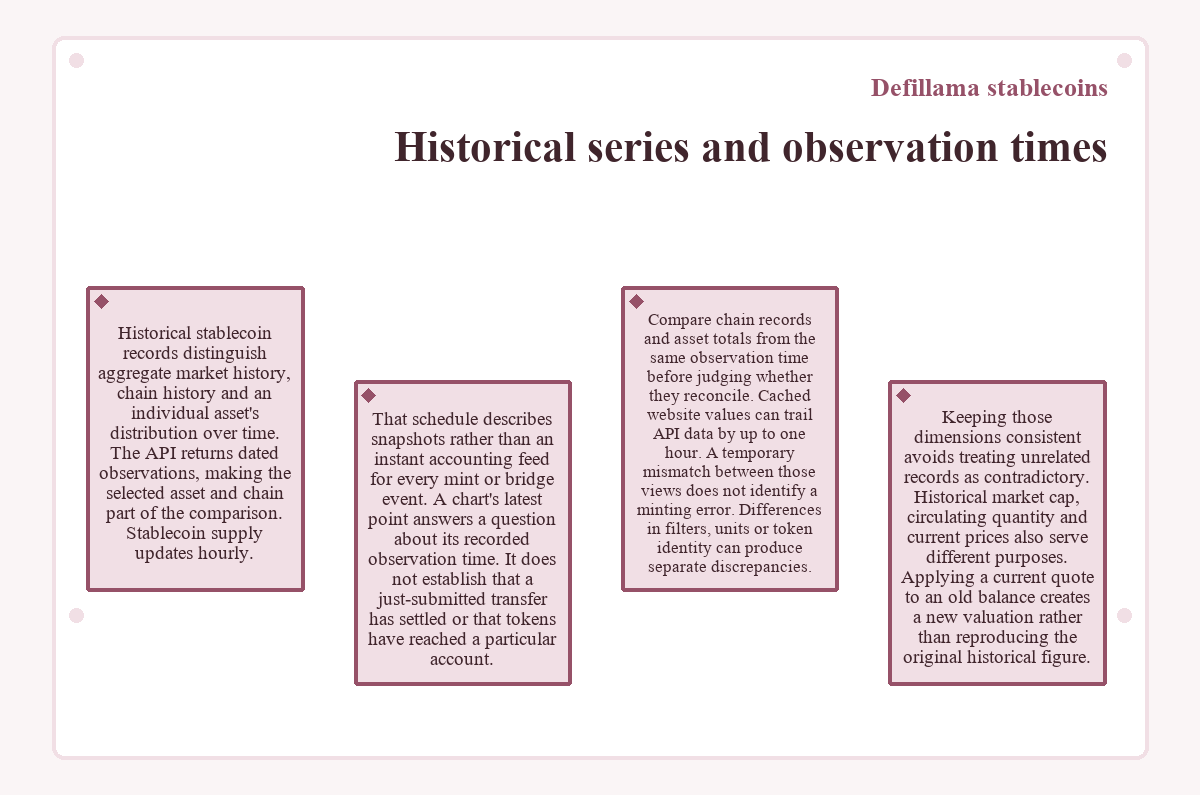
Cached website values can trail API data by up to one hour. A temporary mismatch between those views does not identify a minting error. Differences in filters, units or token identity can produce separate discrepancies. Keeping those dimensions consistent avoids treating unrelated records as contradictory. Historical market cap, circulating quantity and current prices also serve different purposes. Applying a current quote to an old balance creates a new valuation rather than reproducing the original historical figure.
Does a chain balance establish token compatibility?
A chain balance establishes tracked supply on that network, without establishing that a particular application accepts every token representation. Native issuance and bridged balances can have different contract identities and backing arrangements. Their inclusion under a stablecoin label does not make those arrangements interchangeable. The balance's network and token identity must match those supported by the destination. Supply data supports a distribution comparison when those identities align. If they do not align, a chain-wide supply figure cannot establish compatibility for that destination.
Your questions, answered
Can I access stablecoin supply data without a paid subscription?
The free API provides public stablecoin data without authentication. Its coverage includes circulating amounts, aggregate histories, chain histories and individual asset distributions. Paid API access is a separate offering.
Which keys identify peg types in stablecoin adapter balances?
Stablecoin adapters use peg-type keys such as peggedUSD, peggedEUR and peggedVAR for dollar, euro and variable pegs. These are examples within a broader supported set. The key identifies the balance category; it does not describe the token's collateral design, establish redemption eligibility or guarantee that its market price matches its reference value.
What can an adapter return when its issuance or reserve balance is zero?
A supply adapter can return an empty balance object when its minted or unreleased amount is zero. An empty object represents a zero quantity in this case. It does not supply a valuation or describe a bridge balance, whose classification uses a separate origin-chain entry.
Are stablecoin price histories available separately from supply histories?
The stablecoin API provides historical prices separately from its supply and market-cap history requests. Price records include dates and price data. A price series answers how valuation changed; it cannot establish token issuance by itself. Combining historical prices and balances requires matching the asset, observation time and units.
How are raw token balances converted into readable supply amounts?
Raw balances convert to token quantities by dividing by 10 raised to the token's decimal precision. That precision belongs to the token representation. A raw contract integer and an already normalized amount describe different scales. Adapter configuration must match the actual token, so one helper's default precision cannot establish the decimals for every stablecoin.